That’s right. I’m not a complete noob. I learned how to play chess when I was 5 or 6. My mom signed me up for this chess class in Beijing Children’s Palace (北京少年宫), next to Jingshan Park (景山公园). My ancient memory tells me it was not fun, the teacher looked serious, and the room smelled.
Fast forward 30-plus years: I was bored one evening in July and tried to figure out how to kill time. One of my colleagues mentioned he plays on chess.com. It was the first time I heard about this website, and my inner reaction is “do people really play this game online”? Based on the astounding overlaps in our hobbies, I decided to give it a go. And I was immediately hooked.
All I remembered were the most basic rules: how a piece moves, and how checkmate is reached. Castling? The concept is still there in my head but I was surprised to find out that it could go either side. I didn’t know en passant was a thing—I literally googled it and thought chess.com had bugs. I didn’t know stalemate existed. It’s fair to say I had never finished a chess game before.
In the first Rapid game, I lost to a Scholar’s mate, which set my first ELO to 149. The funniest thing is that, when I re-watched The Queen’s Gambit weeks later, I noticed that Beth Harmon also lost her first game to Scholar’s mate in the show!
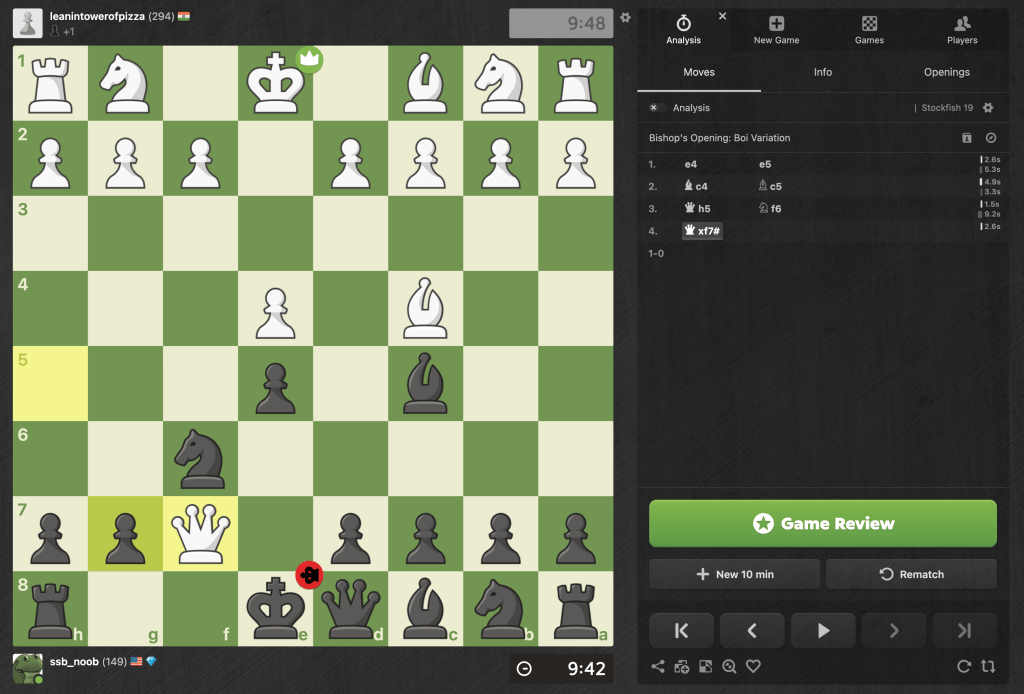
It was only a matter of a few days to climb out of that 100 ELO range thanks to Glicko rating system. At around 500 Elo, games were no longer all about noob moves. Win or lose is still mostly decided by whoever made more dumb mistakes. Pieces were still hanging left and right, and players at this level (yes, me included) were still constantly inventing crazy new openings.
Between 500 and 700, I learned two openings and started to use them repeatedly: the Italian Game as White and the Scandinavian Defense as Black. That made the beginning of each game way faster because I didn’t really have to think much for the first few moves. It also helped my time control a lot which got me into trouble countless times. As an homage to the show, I also tried the Queen’s Gambit a few times, but this conditional-based opening was too advanced and I blundered even more.
Between 700 and 800, blunders like leaving pieces hanging still happened but at a lower rate. And oftentimes, the result was largely decided by whoever made the most atrocious mistake first—it was increasingly difficult to come back after a major blunder. At this level, I also realized that I had simply let mate-in-one opportunities slip past me. I did spend some time working on this by reviewing those missed opportunities and playing Puzzles on chess.com.
I was stuck at 800 for several days, and had to think about adjustments instead of playing in the same way just a few hundred times more.
Not surprisingly, I started to realize having a clear head matters greatly for this game. Not playing more than three games in a row really made a difference to the win rate. My performance after playing a few games in a row deteriorated pretty quickly—I was more likely to tilt and make dumb mistakes. So I played fewer games and did more thorough reviews after each game, focusing on the checkmates and opportunities to win material that I had missed.
Playing blitz helped me learn which moves are inconsequential and could be made a lot faster. It helped my overall time management. However, it does serve as a double-edged sword as I have a higher tendency to move impulsively without fully thinking through the state.
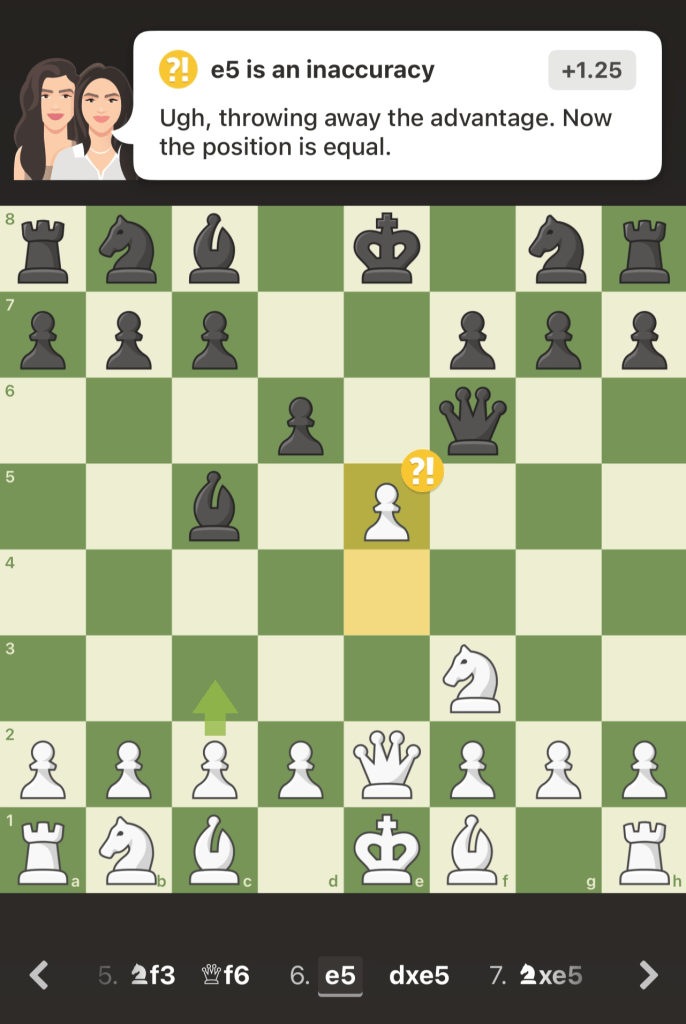
I don’t know where I learned about tempo in chess, but the concept immediately clicked as the same concept exists in StarCraft II. My understanding of tempo had improved over time—like knowing when to push a pawn to put pressure on my opponent, when to develop and when to castle. For instance, moving this pawn to E5 was not the best choice because the attack wouldn’t achieve much and I should have developed central control instead.
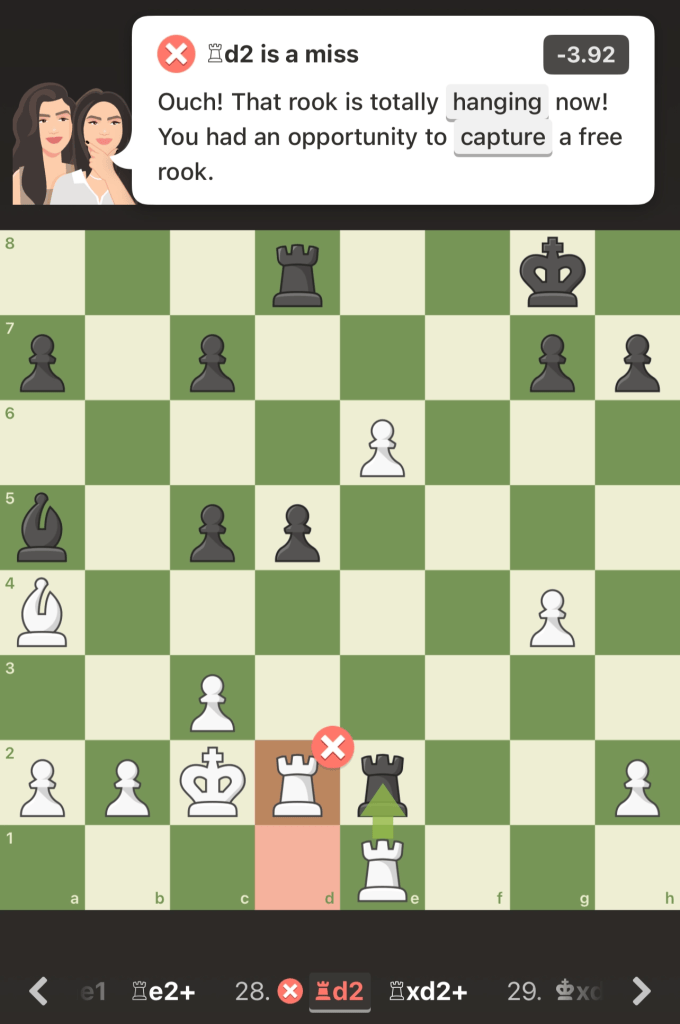
It’s a psychological game! I learned that I sometimes could be hasty, especially under time pressure. The most classic example is this game, where I panicked when I got checked with not much time left, and tried to block the check with one rook, when I could have simply taken that attacking rook with my E1 rook! 🤡
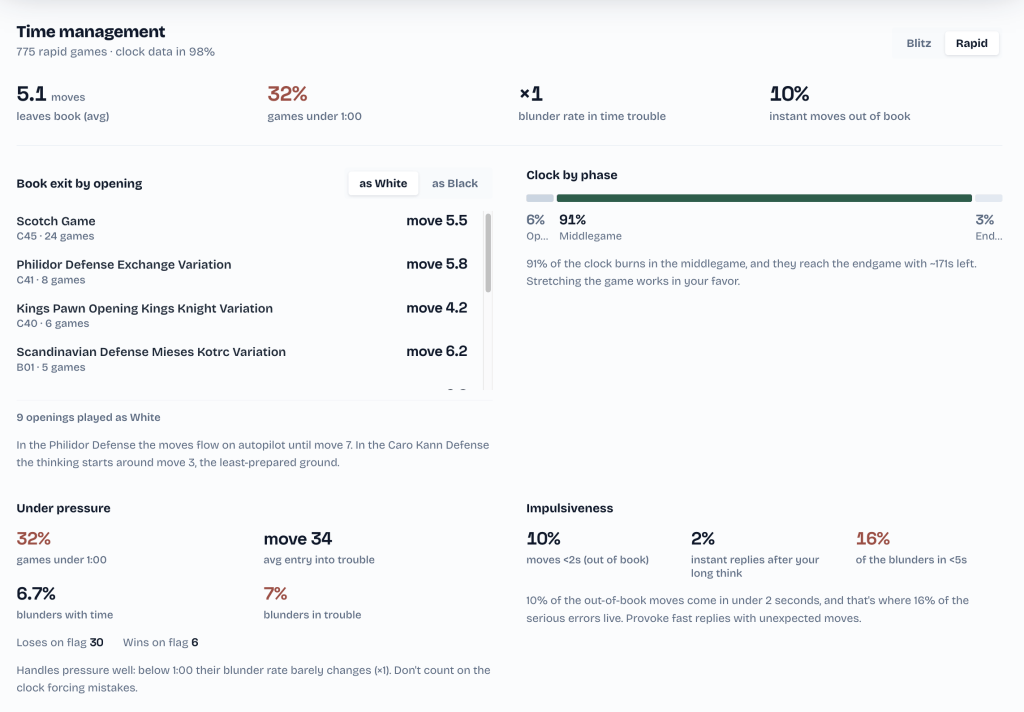
That colleague who brought me to chess world was able to quantify my panic with some numbers from chessstalker.com!
So, after all these, I reached 900 ELO and made it into the top 20% of players at the beginning of August!
I’m really, really glad I discovered chess as a hobby. For years I couldn’t find a replacement for StarCraft 2 that was so intellectually challenging and excitingly complex, with so much to learn and master. Yet, chess doesn’t require the same level of intensity as SC2 where you could lose a game if you look away for 2 seconds (disruptor ball incoming!).

